


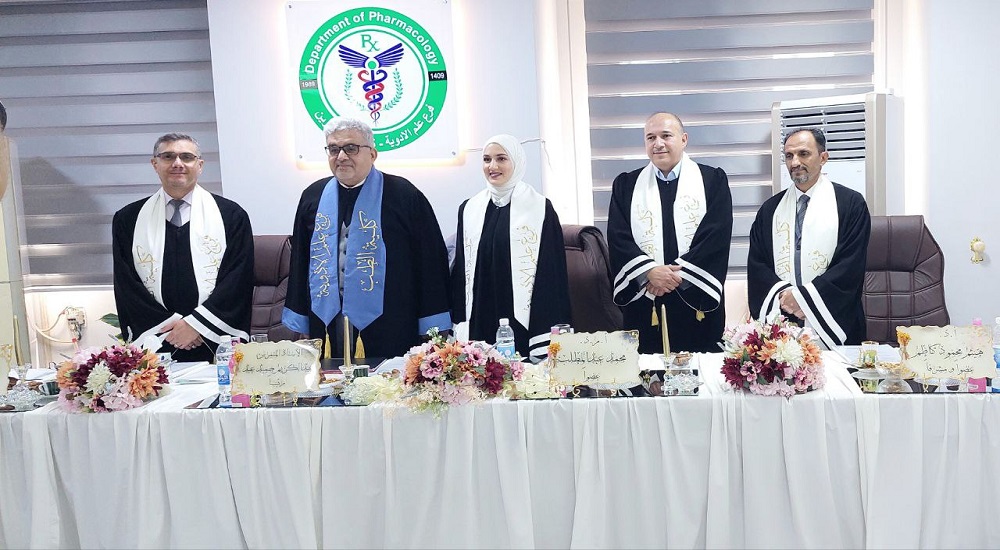
The master's thesis defense of Bayan Jamal Khalil from the Department of Pharmacology
The master's thesis defense of Bayan Jamal Khalil from the Department of Pharmacology was completed on Wednesday, September 4, 2024, with her thesis titled:
"Anti-angiogenic activity of carbohydrazide and triazole derivatives derived from 5-Bromo-1H-indole-2-carboxylic acid: In ex vivo, in vivo, and in vitro animal studies.
"The study aimed to determine the anti-angiogenic activity of two chemical compounds: [N-(1-benzyl-2-oxindolin-3-ylidene)-5-bromo-1H-2-carbohydrazide] and [5-bromo-2-(5-(4-nitrophenyl)-4H-4,2,1-triazole-3-yl)-1H-indole].
It investigated the anti-proliferative activity of these compounds against human umbilical vein endothelial cells (HUVEC) and explored their effects on colon cancer cells (HCT116) by examining the gene expression of vascular endothelial growth factor (VEGF) using real-time polymerase chain reaction (RT-PCR) to identify their potential mechanism of action.The study showed that both chemical compounds significantly inhibited angiogenesis (P < 0.05) in a dose-dependent manner in vivo. The half-maximal inhibitory concentration (IC50) for the compound[N-(1-benzyl-2-oxindolin-3-ylidene)-5-bromo-1H-2-carbohydrazide] was 18.42 µg/mL, and for [5-bromo-2-(5-(4-nitrophenyl)-4H-4,2,1-triazole-3-yl)-1H-indole] it was 25.85 µg/mL. Both compounds significantly reduced free radicals (P < 0.05) in a concentration-dependent manner. The chick chorioallantoic membrane (CAM) assay in vivo confirmed a significant reduction in blood vessels. Additionally, both compounds demonstrated non-toxic effects on human umbilical vein endothelial cells, with IC50 values of 1681 µg/mL and 876.6 µg/mL for the two compounds, respectively. Finally, there was a notable reduction in VEGF gene expression at concentrations of 200 and 400 µg/mL, as observed in the analysis, compared to control cells.
The defense committee consisted of:-
Prof. Dr. Abdul Kareem Hameed Abd
Prof. Dr. Haider Sabah Kadhim
Assist. Prof. Dr. Mohammed Abdulmutalib Abdulbari
Prof. Dr. Haitham Mahmoud Kadhim
The thesis was accepted with distinction.


