

The Supporting Sciences Unit at the College of Medicine Hosts Online Lecture on Ancient Mesopotamian Herbal Medicine, Highlighting Plant Identification Methods and Healing Uses from 4,000 Years Ago
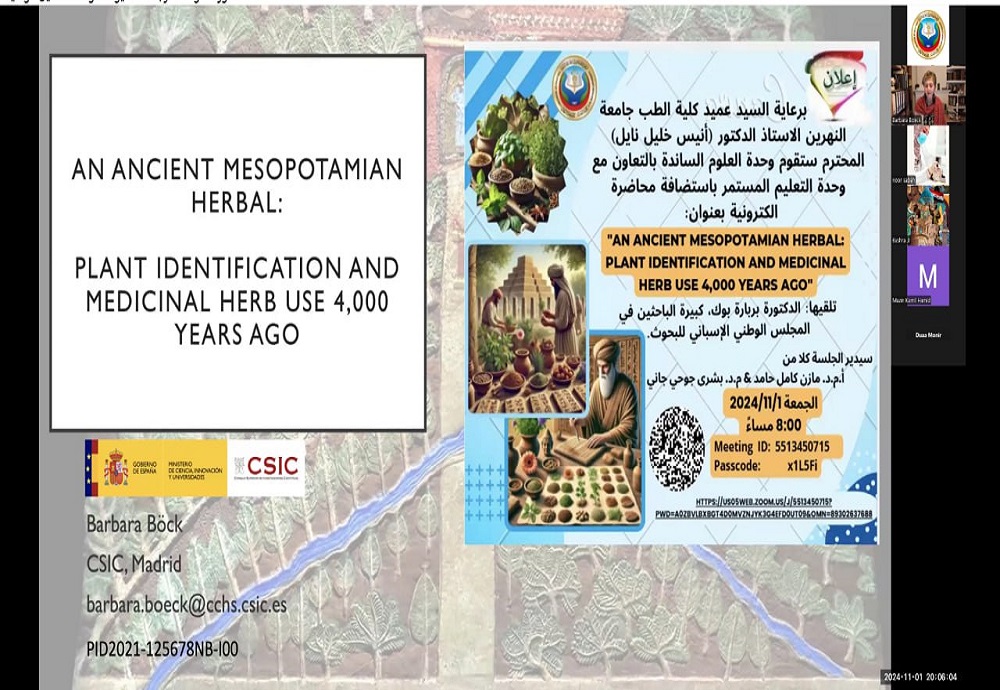
"An Ancient Mesopotamian Herbal: Plant Identification and Medicinal Herb Use 4,000 Years Ago"
In her online lecture, Dr. Böck discussed the healing uses of herbs and the methods for identifying some plants based on their names from that period.
Dr. Böck began by addressing the methods for identifying plant names mentioned in cuneiform texts, noting that these names are often Akkadian. She explained the approach of comparing the roots of Akkadian words with other Semitic languages, such as Arabic, to understand the underlying meanings of plant names. She emphasized that identifying these plants requires a combination of linguistic knowledge and archaeological evidence.
Dr. Böck explained that Assyrian art includes some symbolic representations of plants, showing trees such as pomegranate, fig, and grape. She noted that these depictions sometimes aimed to identify geographical locations, with an abundance of date palms, for instance, indicating the southern regions of Babylon. Despite these representations, she clarified that there was no direct link between the texts and images for plant identification at that time, adding complexity to the process.
Dr. Böck discussed modern techniques for identifying plants, describing how ancient plants can be compared with similar modern plants found in present-day Iraq, such as Bryonia multiflora. She noted that identifying these plants requires collaboration with botanists, like Dr. Shahina Ghazanfar and her colleague, archaeobotanist Mark Nesbitt, who helped identify around 25 medicinal plants used in the first and second millennia BCE.
In the final section, Dr. Böck highlighted the earliest texts written about the relationship between humans and plants, dating back to the end of the fourth millennium BCE. She explained that these texts were used to teach beginners about agricultural and botanical terminology, reflecting the strong bond between plants and people in ancient Mesopotamian agricultural communities.

