

The First Study in Iraq to Investigate the Association Between Genetic Variations and Type 2 Diabetes Markers
The Department of Chemistry and Biochemistry at the College of Medicine, Al-Nahrain University, discussed the doctoral dissertation of student Furqad Abduljawad Al-Baydani, entitled:
“Evaluation of Plasma Decoy Receptor 3, Phospholipid Transfer Protein Concentration, and Single Nucleotide Polymorphism of ATP Binding Cassette Transporter A1 in Pre-Diabetes and Newly Diagnosed Type 2 Diabetes Mellitus.”
The study aimed to evaluate single nucleotide polymorphisms (SNPs) rs1800977, rs2740483, and rs1800976 in the ATP-binding cassette transporter A1 (ABCA1) gene, in addition to measuring the concentrations of ABCA1, phospholipid transfer protein, and Decoy receptor 3 (DcR3) in the serum of Iraqi patients with pre-diabetes and newly diagnosed type 2 diabetes mellitus.
The research further sought to explore the possible association between these biomarkers and certain clinical and metabolic features in the early stages of glucose dysregulation. It investigated whether single or combined point mutations in the ABCA1 gene sequence could contribute to the onset of type 2 diabetes by affecting lipid metabolism pathways, insulin signaling, and the efficiency of pancreatic insulin-producing beta cells. These parameters were selected due to their potential link with the initiation and progression of the disease, providing a deeper understanding of the genetic and molecular pathways that may predispose individuals to diabetes.
This is the first study of its kind in Iraq to investigate the relationship between genetic variants in the ABCA1 gene (SNPs: rs1800977, rs2740483, rs1800976) and related protein levels, as well as DcR3 and phospholipid transfer protein, in pre-diabetic and newly diagnosed type 2 diabetic patients. The study is also distinguished as the first to correlate these genetic variations with inflammatory markers and metabolic disturbances in the early stages of glucose dysregulation, contributing to a better understanding of the molecular and pathological mechanisms that may play a role in the development of type 2 diabetes.
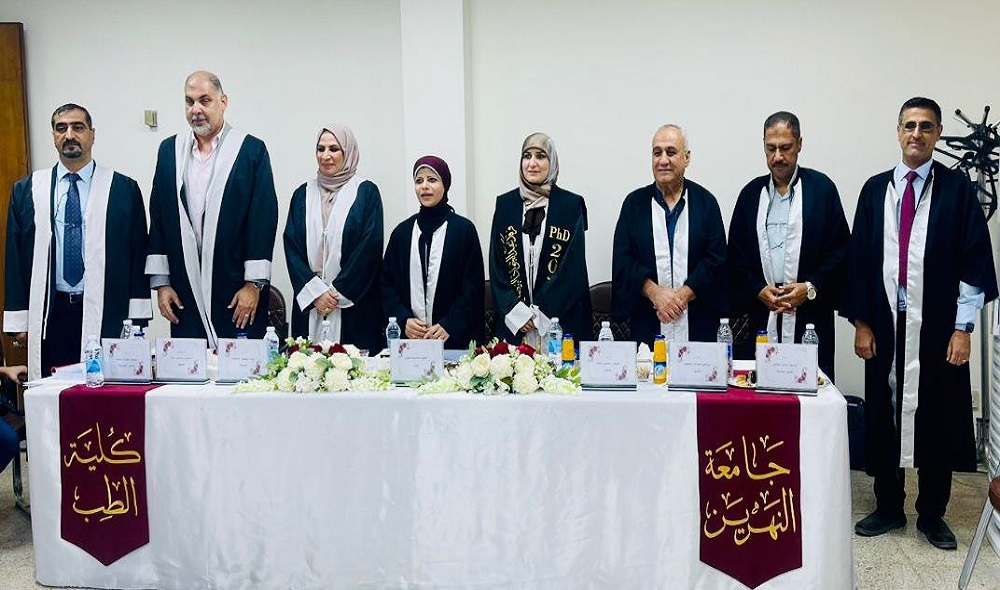
The discussion committee consisted of:
Prof. Dr. Estabraq Abdul-Rasool Kwayri (Chair)
Prof. Dr. Aref Sami Malik (Member)
Prof. Dr. Rana Majeed Hameed (Member)
Assoc. Prof. Dr. Ibrahim Abdullah Mahmood (Member)
Assoc. Prof. Dr. Hassan Hussein Taha (Member)
Prof. Dr. Mohammed Imran Hamza (Member & Supervisor)
Prof. Dr. Mahmood Shakir Khudair (Member & Supervisor)
The dissertation was successfully accepted with a grade of Excellent.
Division of Media and Government Communication
College of Medicine – Al-Nahrain University
