

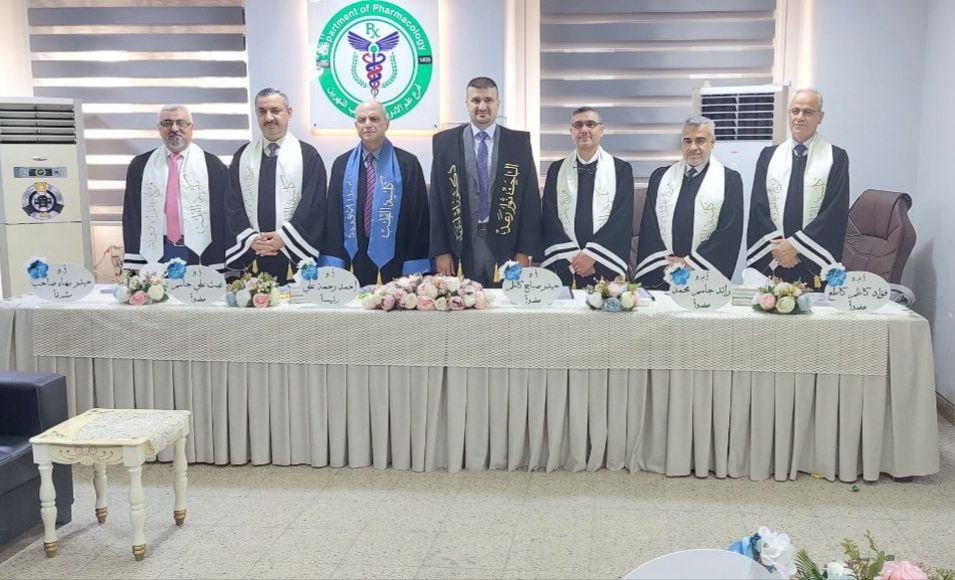
The doctoral thesis defense in the Department of Pharmacology, College of Medicine, University of Al-Nahrain, presented by the student Nawar Raad Hussein.
"The Anti-Angiogenesis Effect of Phenyl Azoserine Derivatives C26H22N4O4 and C28H23N5O4: In Vivo and In Vitro Assays in Rats"
Identify anti-metastatic agents and the anti-angiogenesis activity of the phenyl azoserine derivatives C28H23N5O4 and C26H22N4O4 both in vitro, in vivo, in laboratory settings, and in silico, as well as to verify the gene expression of Vascular Endothelial Growth Factor (VEGF) in Kaposi Sarcoma cells.
Both derivatives exhibited the ability to inhibit angiogenesis using the mouse aortic ring assay and the chicken chorioallantoic membrane (CAM) assay. Both derivatives also demonstrated anti-proliferative properties when tested on human umbilical vein endothelial cells (HUVECs) and cancer cells from the colon and breast. Both derivatives led to a significant reduction in VEGF, as measured by quantitative reverse transcription polymerase chain reaction (qRT-PCR) at a concentration of 200 µg/mL. The results were further supported by computational analysis, which indicated several targets, including protein G receptors, integrins, caspase 1, neprilysin, and angiotensin-converting enzyme. Molecular docking of the phenyl azoserine derivatives (C28H23N5O4 and C26H22N4O4) showed a precise linear potential (PLP) of 91.496 and 81.783, respectively, and they had low binding energy for hypoxia-inducible factor 1 alpha (HIF-1α), angiopoietin-1, and fibroblast growth factor (FGF).

