

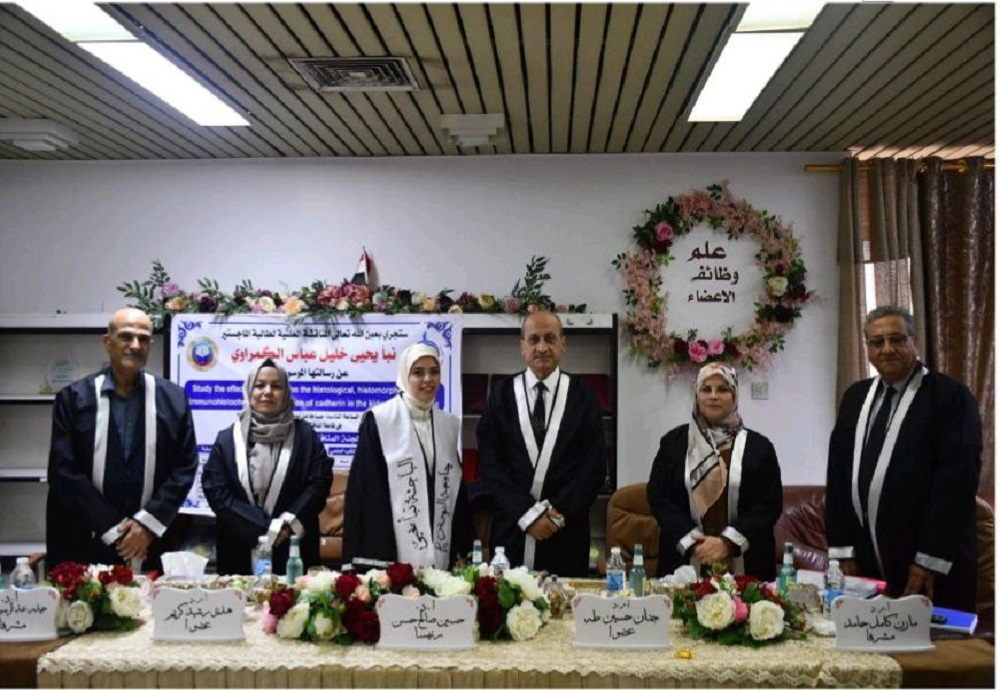
The master's thesis defense of the student (Nabaa Yahya Khalil) in the Department of Physiology / Medical Physics at the College of Medicine, Al-Nahrain University.
The master's thesis of the student (Nabaa Yahya Khalil) was discussed in the Department of Physiology / Medical Physics at the College of Medicine, Al-Nahrain University, entitled:
“Study the Effect of Copper Oxide Nanoparticles on the Histological, Histomorphometrical, and Immunohistochemical Expression of Cadherin in the Kidneys of Male Mice.”
Study Objective:
To evaluate the effects of copper oxide nanoparticles on the histological, histomorphometric, and immunohistochemical expression of cadherin in the kidneys of male mice. The kidney tissues showed an increase in intraluminal aggregates with glomerular infiltration, leading to dilation of the tubular system (PCT, DCT, CD) of the glomeruli in each kidney. Vascular congestion was observed in the renal tissue of animals treated with high doses of CuO nanoparticles, compared to those given lower doses or the control group. The glomeruli in the kidney tissues appeared smaller in size, with more apoptotic cells. Bowman’s capsules surrounding the glomeruli appeared enlarged due to increased glomerular filtrate within them, in addition to dilation of the tubular system caused by excessive intraluminal secretion from the pre-arteriolar capillaries surrounding the tubular system of the renal glomeruli. Kidney tissues also showed vascular congestion, intraluminal eosinophilic aggregates with glomerular infiltration, and impaired tubular absorption, resulting in dilation of the tubular system of the renal glomeruli. Immune cell infiltrations were observed, as lymphocytic macrophages were noted in animals treated with high doses of CuO nanoparticles compared to those receiving lower doses or the control group, due to an immune reaction of immune cells toward these particles. The histological features of the renal cortex of animals exposed to different doses of CuO nanoparticles revealed an increase in the expression of E-cadherin proteins with increasing treatment dose, as seen in groups A, B, and C compared to the control group (D). This was manifested as dark brown staining using anti-cadherin IHC and could be quantified by the Aprio program. The results demonstrated increased expression of E-cadherin in the kidney tissues of animals receiving high doses of CuO nanoparticles, indicating their affinity for E-cadherin proteins, which appeared as dark brown staining indicating positive expression, especially in groups A, B, and C compared to the control group (D).
Conclusions:
CuO nanoparticles caused an increase in glomerular filtrate accumulation within the lumen, leading to dilation of the tubular system (PCT, DCT, CD) of the renal glomeruli. Vascular congestion in the renal tissue was observed. The renal glomeruli appeared smaller, with areas of dead, ghost-like, or anucleated cells. Bowman’s capsules became enlarged due to increased glomerular filtrate within them, along with dilation of the tubular system as a result of increased intraluminal secretion from the pre-arteriolar capillaries surrounding the tubular system of the renal glomeruli.
The renal tissue and interstitial spaces showed congested blood vessels due to CuO nanoparticles, which stimulated lymphocytic infiltration of immune cells (lymphocytes and monocytes such as macrophages) into the kidney tissue. The toxic effects of CuO nanoparticles on kidney tissue led to apoptosis. Higher doses of CuO nanoparticles revealed an increase in the expression of E-cadherin proteins, indicating that copper has an affinity for E-cadherin. The toxicity of CuO nanoparticles in mouse kidney tissue was attributed to their size (38–50 nm in diameter), which may obstruct or affect the filtration slit diaphragm in the renal glomeruli, causing impairment of glomerular filtration, although the slit diaphragm typically ranges from 30–40 nm in width.
The Examination Committee consisted of:
Prof. Dr. Hussein Saleh Hassan – Chair
Asst. Prof. Dr. Huda Rasheed Kareem – Member
Asst. Prof. Dr. Jenan Hussein Taha – Member
Asst. Prof. Dr. Mazen Kamel Hamed – Member and Supervisor
Prof. Dr. Haider Abdulrasool Jafar – Member and Supervisor
The thesis was accepted with a grade of Excellent.
