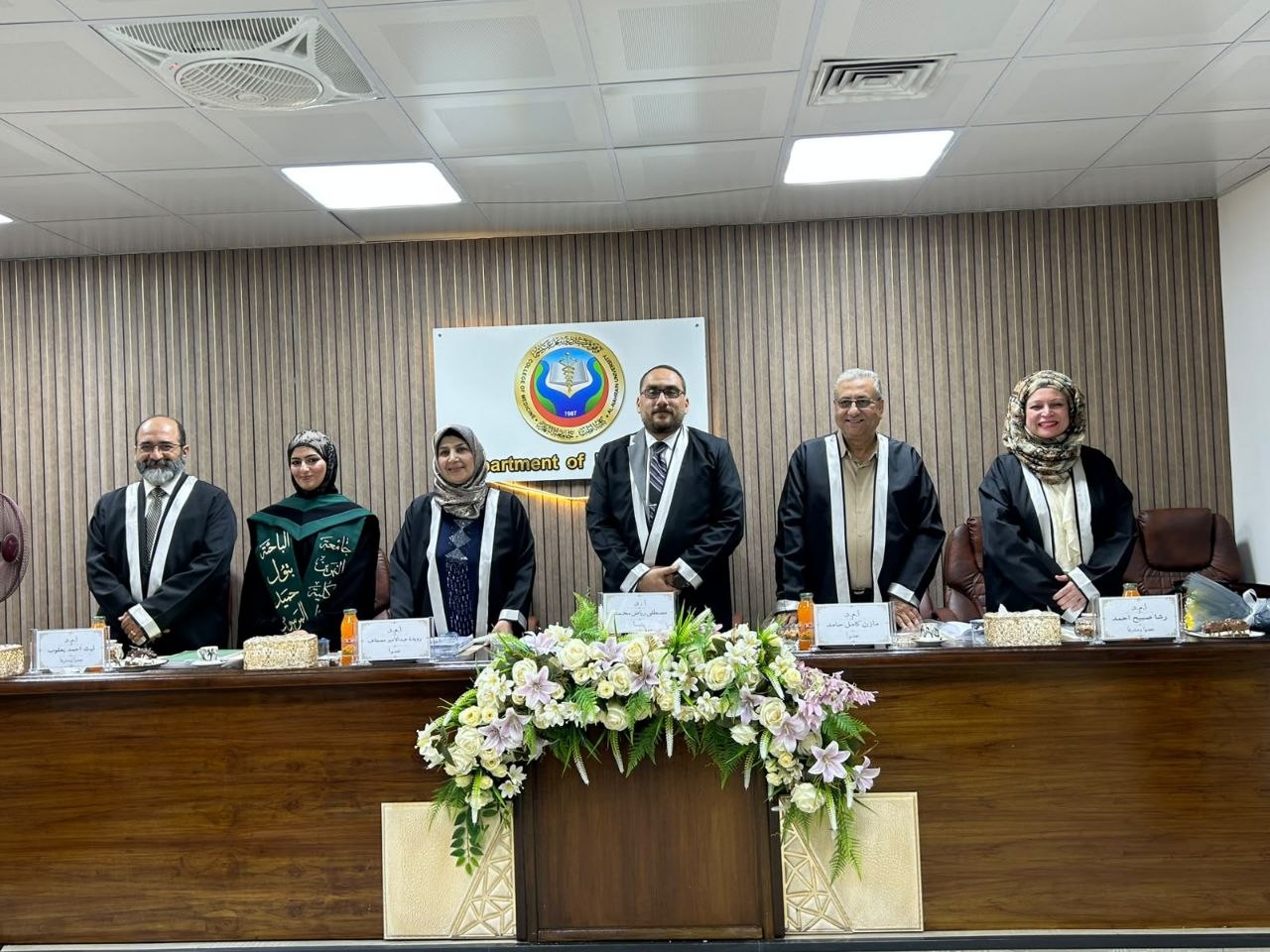


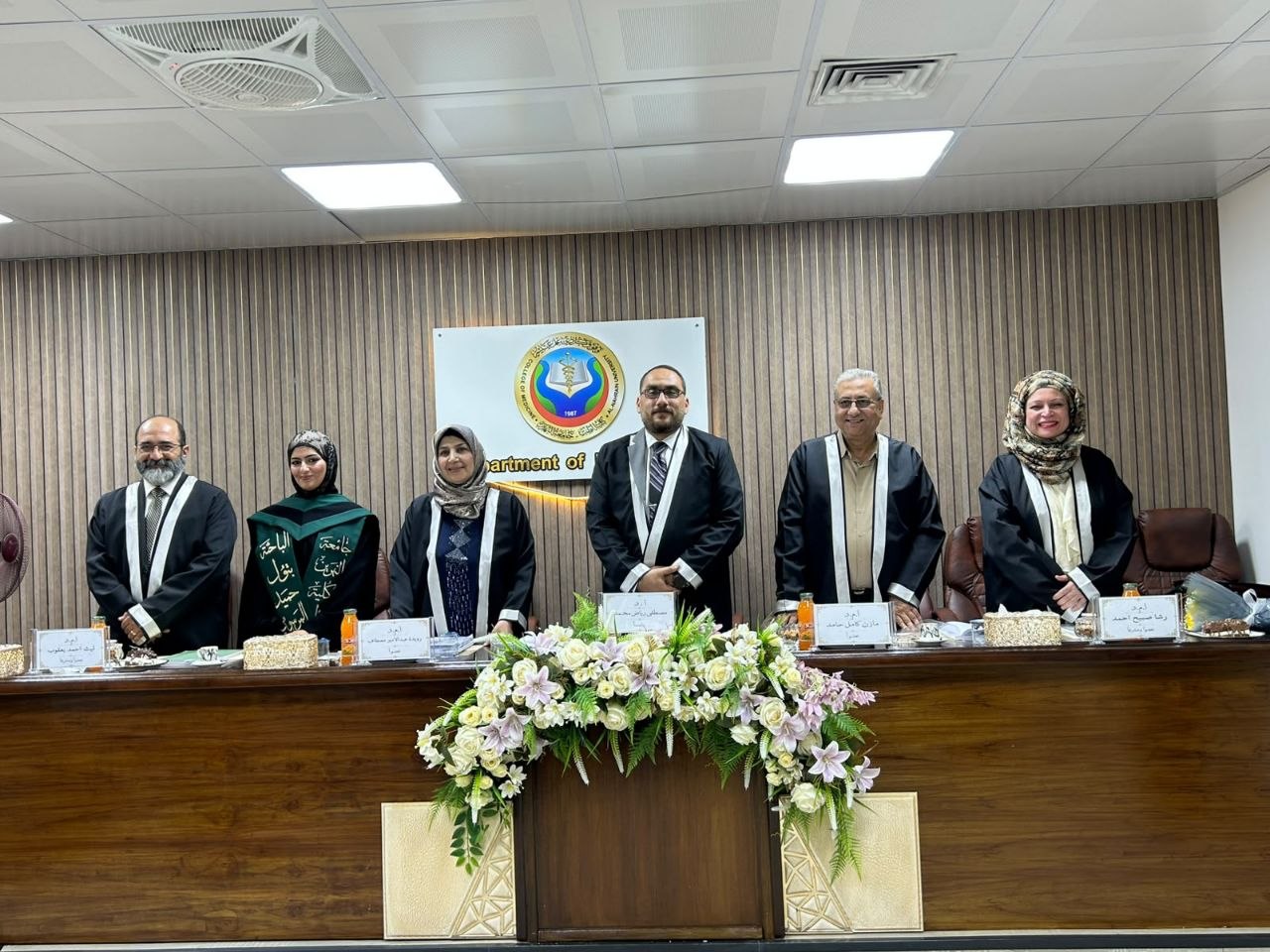
Al-Nahrain University College of Medicine Discusses a Master’s Thesis Investigating the Anticancer Activity of Green-Synthesized Zinc Oxide Nanoparticles Derived from Clove Extract and Their Combination with Vincristine against A2780 Ovarian Cancer Cells
On Tuesday, September 1, 2026, the College of Medicine at Al-Nahrain University, Department of Physiology and Medical Physics, held a discussion of the Master’s thesis submitted by Batool Hameed Rasheed, entitled:
“Anticancer activity of biosynthesized zinc oxide nanoparticles combined with vincristine against A2780 ovarian cancer cells and HdFn normal cells.”
The study aimed to evaluate the anticancer activity of zinc oxide nanoparticles (ZnO NPs) biosynthesized using clove extract (Syzygium aromaticum), and to investigate their effects when combined with the chemotherapeutic agent vincristine against A2780 ovarian cancer cells and normal human dermal fibroblast (HDFn) cells.
The findings demonstrated the successful biosynthesis of zinc oxide nanoparticles using clove extract. Physicochemical characterization analyses, including FTIR, UV–Vis, XRD, EDX, AFM, DLS, and FE-SEM, confirmed the formation of ZnO nanoparticles and characterized their structural and surface properties.
AFM analysis revealed an average particle diameter of 59.85 nm, with the nanoparticles exhibiting predominantly spherical and quasi-spherical morphology. EDX analysis confirmed the presence of zinc (Zn) and oxygen (O) as the principal constituent elements of the nanoparticles, supporting the successful formation and purity of the ZnO NPs. Furthermore, zeta potential analysis yielded a value of −20.67 mV, indicating relatively good surface stability of the nanoparticles.
The results of the MTT assay showed that the ZnO NPs–vincristine combination inhibited the growth of A2780 ovarian cancer cells in a concentration-dependent manner. The IC₅₀ value of vincristine decreased from 449.3 µg/mL to 88 µg/mL when combined with ZnO nanoparticles in A2780 cells, indicating enhanced cytotoxic activity against the cancer cells. In contrast, normal HDFn cells exhibited a higher IC₅₀ value of 449.3 µg/mL.
Statistical analysis using Two-way ANOVA demonstrated highly significant effects of both concentration and treatment type on the viability of A2780 cells (p < 0.001), whereas the interaction between the two factors was not statistically significant (p = 0.546). The Games–Howell post hoc analysis showed that the ZnO NPs–vincristine combination significantly reduced A2780 cell viability compared with vincristine alone at all tested concentrations and was more effective than ZnO NPs alone at most concentrations.
In normal HDFn cells, however, the combination did not produce a statistically significant difference compared with vincristine alone at any of the tested concentrations, indicating that combining ZnO NPs with vincristine did not result in a significant increase in cytotoxicity toward normal cells.
These findings support the promising potential of biosynthesized ZnO nanoparticles in combination with vincristine as a combined therapeutic approach against ovarian cancer, owing to the enhanced anticancer activity observed against A2780 cells while maintaining only a limited and statistically non-significant additional cytotoxic effect on normal HDFn cells.
Thesis Discussion Committee
The discussion committee consisted of:
-
Prof. Dr. Mustafa Riyadh Mohammed – Chair
-
Assist. Prof. Dr. Ruwayda Abdul Amir Mustafa – Member
-
Assist. Prof. Dr. Mazin Kamel Hamed – Member
-
Prof. Dr. Rasha Subaih Ahmed – Member and Supervisor
-
Prof. Dr. Laith Ahmed Yaqoub – Member and Supervisor
The thesis was successfully approved with an “Excellent” grade.
Media and Government Communication Division
College of Medicine – Al-Nahrain University