

Master’s Thesis Defense at the College of Medicine, Al-Nahrain University Examines the Effect of Pterygium Surgery on Visual Acuity, Corneal Curvature, and Astigmatism
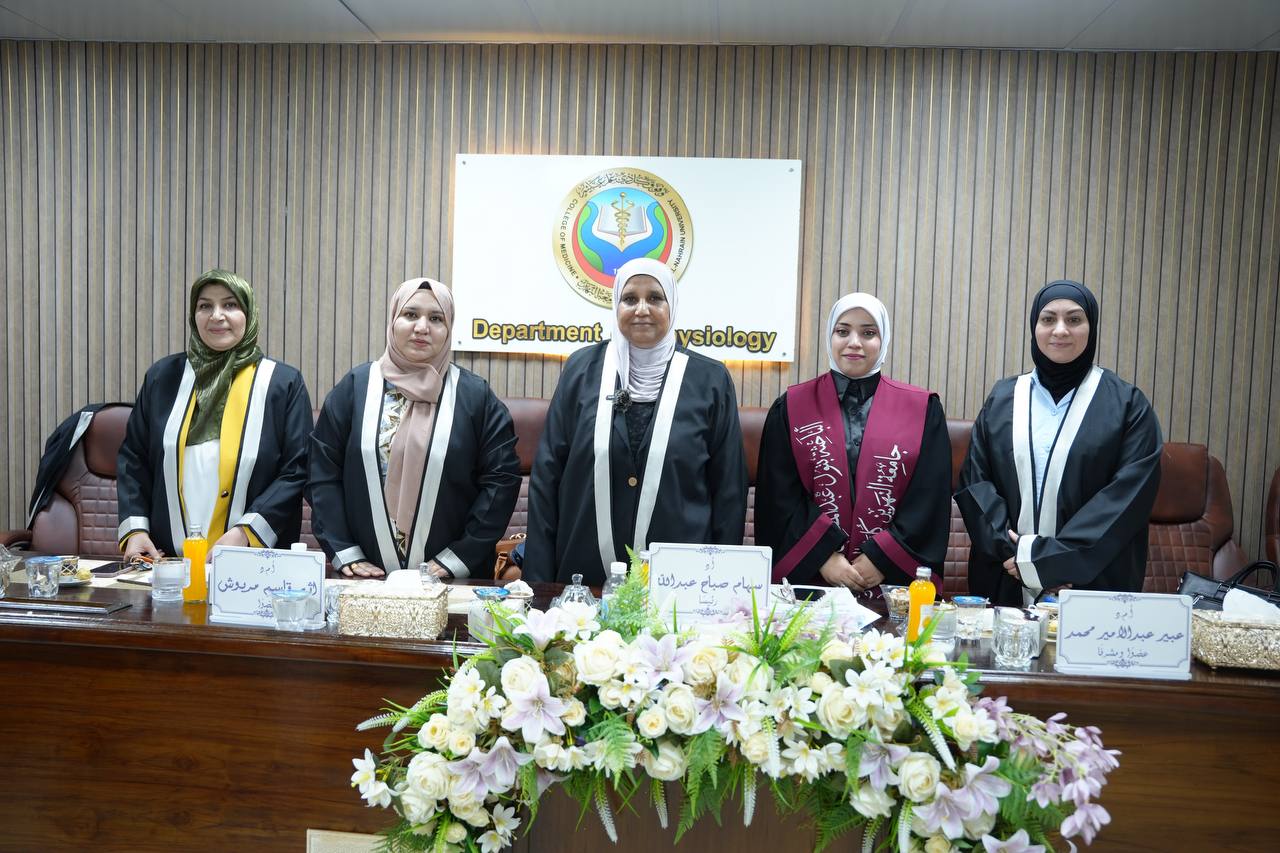
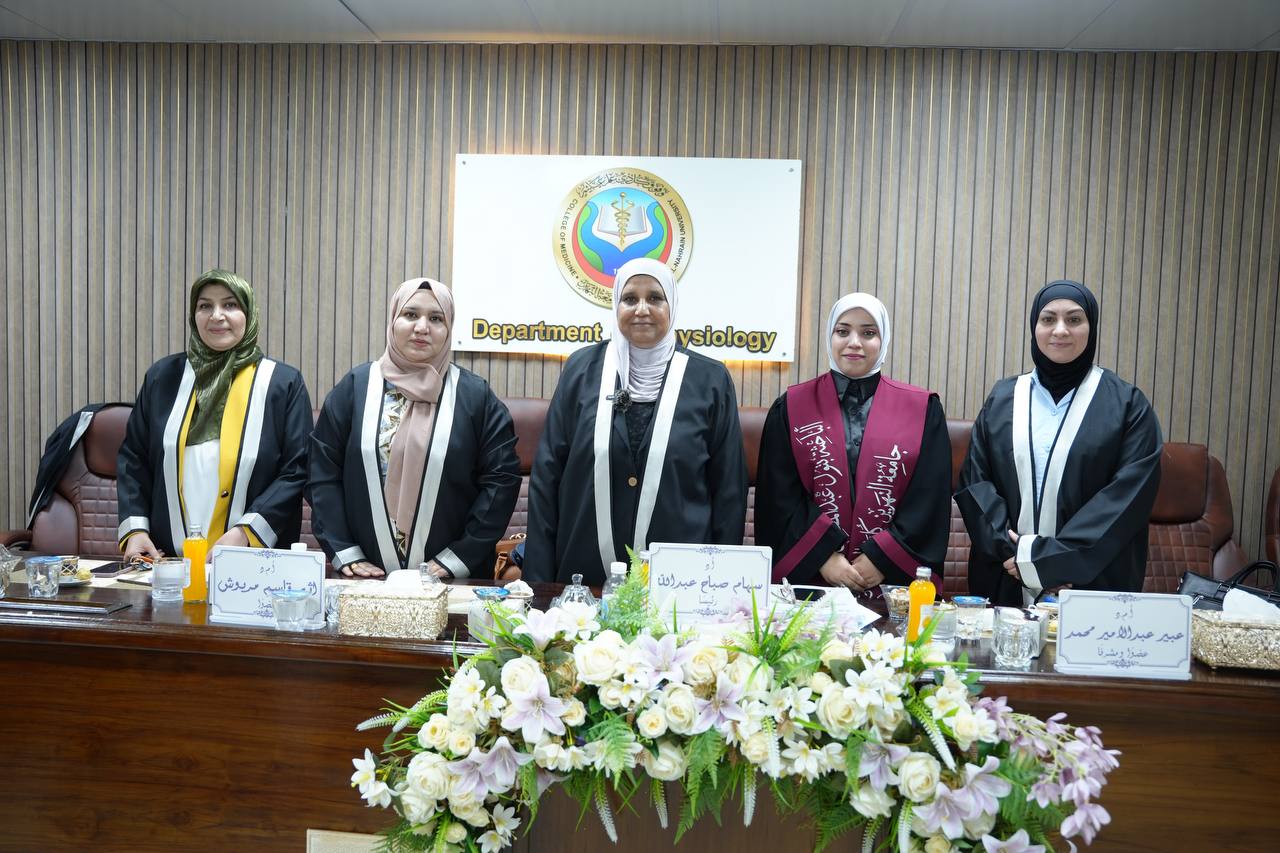
A Master’s thesis defense was held at the College of Medicine, Al-Nahrain University, for Master’s student Batool Abdulmutalib Badr, from the Department of Physiology / Medical Physics. The thesis was entitled:
“ Effect of pterygium surgery on visual acuity (VA), corneal curvature (K1 and K2 readings), and astigmatism.”
The study aimed to analyze the optical and physical changes in corneal refraction and curvature associated with pterygium; quantify the degree of induced astigmatism and its improvement following surgical excision; assess changes in visual acuity before and after surgery using standardized optical instruments; and interpret the findings based on the principles of physical optics, particularly refraction.
A prospective interventional study was conducted on 40 patients (40 eyes), including 28 males and 12 females, with a mean age of 56.5 ± 15.6 years and an age range of 18–84 years. The patients were diagnosed with varying degrees of pterygium: Grade 1: n = 1; Grade 2: n = 7; Grade 3: n = 20; and Grade 4: n = 12. All patients underwent pterygium excision with conjunctival autografting.
Three standardized clinical instruments were used:
-
Snellen visual acuity chart for measuring visual acuity.
-
An autorefractometer, which uses near-infrared light to objectively measure refractive error, including spherical and cylindrical refractive errors and the cylinder axis.
-
A corneal topography imaging device based on Scheimpflug technology, which reconstructs a three-dimensional model of the anterior segment from tomographic images and measures K1 and K2 from sagittal curvature maps using the keratometric formula P = (n−1)/r, where n represents the corneal refractive index and r represents the radius of corneal curvature, with n = 1.3375.
All parameters were recorded preoperatively and six weeks postoperatively, with the level of statistical significance set at p ≤ 0.05.
Visual acuity improved significantly, from 0.573 ± 0.192 to 0.703 ± 0.146 (mean change: 0.130 ± 0.079; p < 0.0001).
K1 showed no statistically significant change, decreasing from 41.587 ± 1.950 D to 41.562 ± 1.942 D (mean change: −0.025 ± 0.177 D; p = 0.37778), indicating that the optical distortion induced by pterygium predominantly affects the steeper corneal meridian.
In contrast, K2 decreased significantly from 46.206 ± 1.687 D to 44.962 ± 1.577 D (mean change: −1.244 ± 0.489 D; p < 0.0001). This finding corresponds to an increase in the radius of curvature of the steeper corneal meridian and reflects a measurable biomechanical relaxation of the anterior corneal surface following the removal of fibrovascular traction.
Astigmatism also decreased significantly, from 4.575 ± 1.496 D to 3.379 ± 1.278 D (mean change: −1.196 ± 0.492 D; p < 0.0001).
Stratified analysis by pterygium grade revealed a grade-dependent pattern, with higher grades of pterygium associated with greater preoperative astigmatism and greater postoperative visual improvement.
Significant improvements in astigmatism, K2, and visual acuity were observed regardless of the history of ultraviolet/heat exposure or previous surgical history (p ≤ 0.05), while K1 remained stable across all subgroups.
Thesis Defense Committee
-
Prof. Dr. Siham Sabah Abdullah — Chair
-
Asst. Prof. Dr. Hind Ahmed Mahdi — Member
-
Asst. Prof. Dr.. Athir Qasim Maryoush — Member
-
Asst. Prof. Dr. Ruwaida Abdul-Amir Mustaf — Member and Supervisor
-
Asst. Prof. Dr. Abeer Abdul-Amir Mohammed — Member and Supervisor
The thesis was accepted with an Excellent grade.
Media and Government Communication Division
College of Medicine – Al-Nahrain University