

Al-Nahrain University College of Medicine Discusses a Master’s Thesis on Employing Nanocomposites to Enhance the Effectiveness of Breast Cancer Treatment
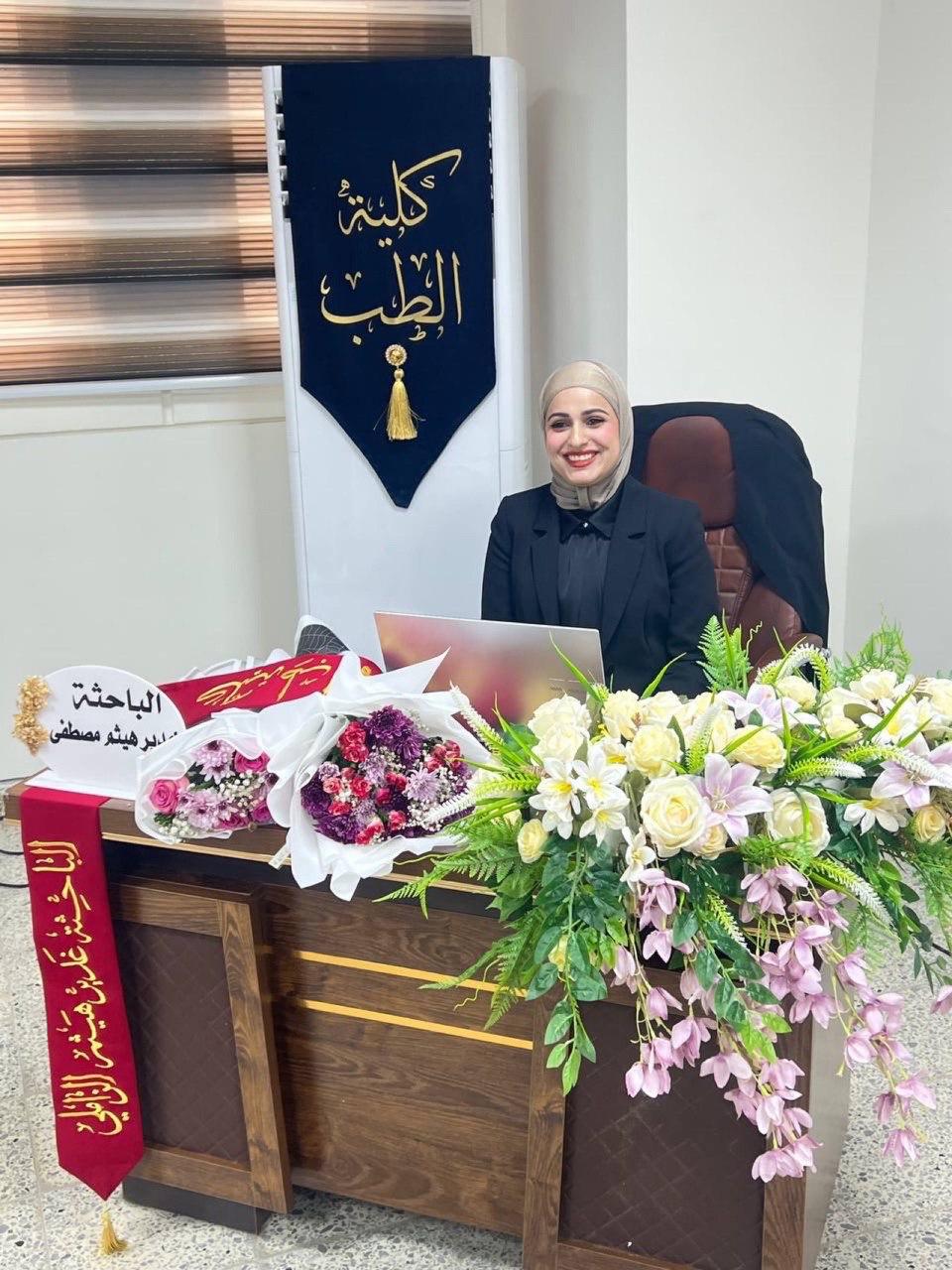
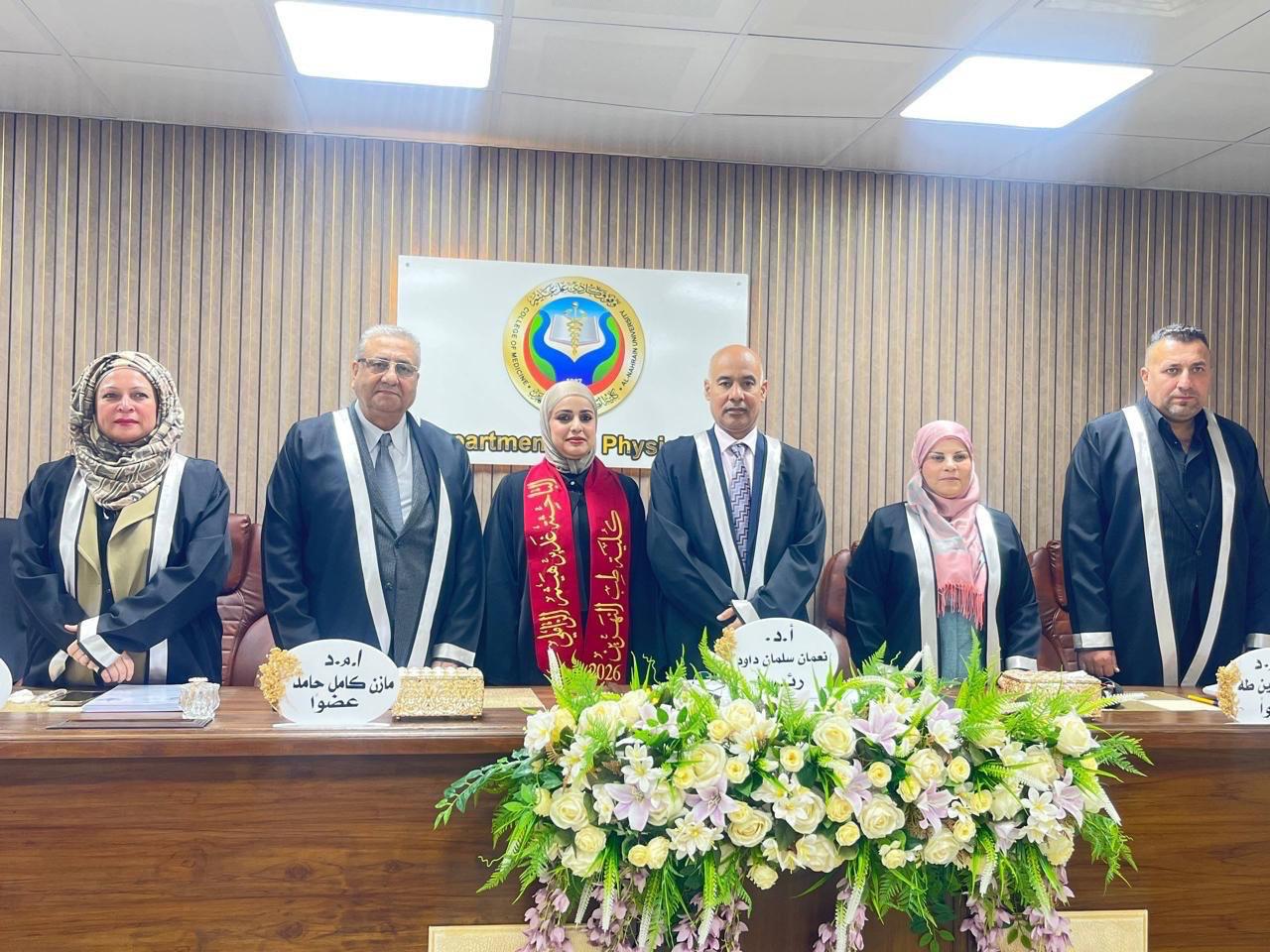
The Department of Physiology / Medical Physics at the College of Medicine, Al-Nahrain University, held the defense of the Master’s thesis submitted by the student Ghadeer Haitham Mustafa Al-Zamli on Thursday, March 5, 2026. The thesis was entitled:
“Study the Effect of Au/ZnO Nanocomposites Synthesized by Laser Ablation on Anticancer Activity of Palbociclib on Breast Cancer Cell Line.”
The study focused on the synthesis, characterization, and biological evaluation of gold/zinc oxide nanocomposites and their mixtures with the anticancer drug Palbociclib (PLB), aiming to enhance their therapeutic efficacy against MCF-7 breast cancer cells.
The Au/ZnO nanocomposites were synthesized using the Pulsed Laser Ablation in Liquid (PLAL) technique, followed by the preparation of PLB-loaded mixtures in ratios of 50/50, 75/25, and 25/75. Comprehensive physicochemical characterization was performed using UV-Visible spectroscopy (UV-Vis), X-ray diffraction (XRD), Fourier Transform Infrared spectroscopy (FTIR), Transmission Electron Microscopy (TEM), supported by Zeta potential analysis.
The results confirmed the formation of highly crystalline Au/ZnO nanocomposites with crystallite sizes ranging from 23–25 nm, predominantly spherical in shape, while PLB exhibited an amorphous structure. PLB-rich formulations demonstrated better dispersion stability due to higher negative surface charge values.
Transmission Electron Microscopy revealed that the 25/75 mixture formed small spherical particles, whereas the 75/25 mixture produced larger star-shaped aggregates. Biological evaluation showed that cytotoxicity was strongly dependent on the nanostructural properties, as assessed using the MTT assay.
Both pure PLB and Au/ZnO nanocomposites demonstrated notable anticancer activity; however, the PLB-loaded nanocomposites showed enhanced anticancer effects, with the 25/75 formulation achieving the highest inhibition rate (100%) and causing severe morphological damage to MCF-7 cells.
The antioxidant activity, evaluated using the DPPH free radical scavenging assay, confirmed that PLB-rich mixtures possessed superior radical-quenching capability. This effect is attributed to the synergistic interactions between the electron-donating groups of PLB and the catalytic surface of Au/ZnO nanoparticles.
The study identified the Au/ZnO nanocomposite (25%) + PLB (75%) formulation as the most promising candidate for further biomedical research.
Examination Committee:
* Prof. Dr. Nu’man Salman Dawood – Chair
* Assist. Prof. Dr. Mazen Kamel Hamed – Member
* Assist. Prof. Dr. Jinan Hussein Taha – Member
* Prof. Dr. Rasha Sabeeh Ahmed – Member and Supervisor
* Prof. Dr. Haider Ahmed Shamran – Member and Supervisor
The thesis was approved with an Excellent grade.
Media and Government Communication Division
College of Medicine – Al-Nahrain University