

Master’s Thesis at Al-Nahrain College of Medicine Investigates the Efficacy of Bacteriophages Against Multidrug-Resistant Bacteria
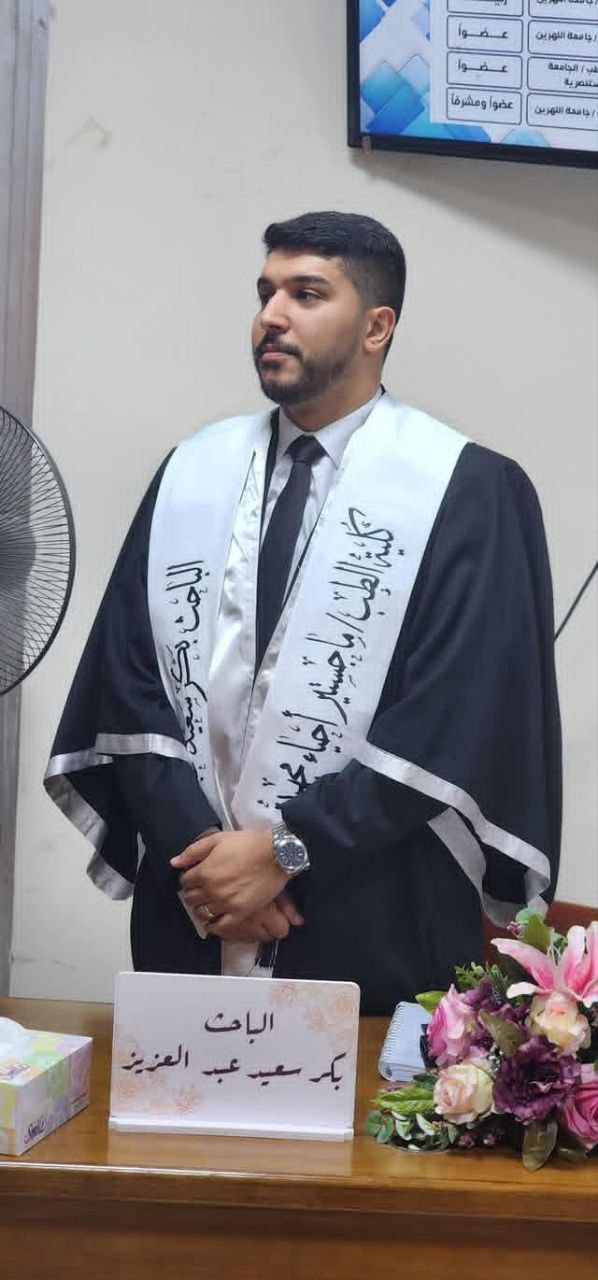
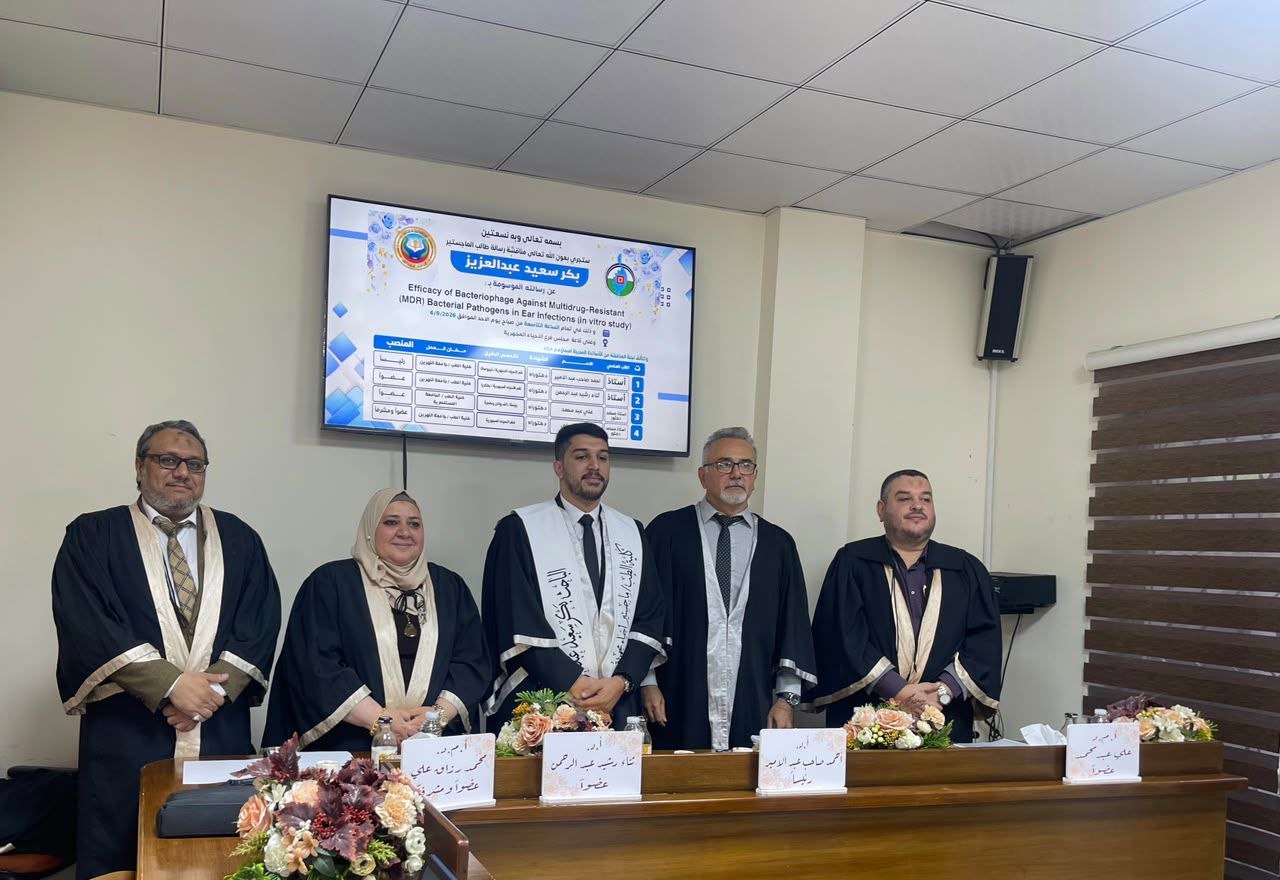
On Sunday, September 6, 2026, a master’s thesis defense was held at the College of Medicine, Al-Nahrain University, Department of Microbiology, for master’s student Baker Saeed Abdul-Aziz, whose thesis was entitled:
“Efficacy of Bacteriophage Against Multidrug-Resistant (MDR) Staphylococcus aureus and Pseudomonas aeruginosa in Chronic Suppurative Otitis Media (in vitro study)”
The study aimed to isolate and evaluate the lytic efficacy of locally isolated bacteriophages against multidrug-resistant strains of S. aureus and P. aeruginosa isolated from patients with ear infections, and to compare their efficacy with conventional antibiotics.
The objectives included characterizing the bacterial isolates and determining their antimicrobial resistance patterns; isolating and characterizing specific lytic bacteriophages, including determination of their titers and purification; formulating species-specific phage cocktails for each bacterial species; comparing the performance of individual phages versus phage cocktails in suppressing the emergence of bacterial resistance; assessing the host-range coverage of the phage cocktails; and quantifying the extent of phage-mediated biofilm inhibition.
The results showed that, regarding antimicrobial resistance, all 20 P. aeruginosa isolates (100%) were classified as extensively drug-resistant (XDR), demonstrating complete resistance to aminoglycosides, fluoroquinolones, and aztreonam. All 10 S. aureus isolates (100%) were methicillin-resistant S. aureus (MRSA) and multidrug-resistant, while remaining susceptible only to glycopeptides, linezolid, and a limited number of last-line antimicrobial agents.
Regarding phage isolation, a total of 35 lytic bacteriophages were isolated, including 24 active against P. aeruginosa and 11 against S. aureus, with titers of approximately 10⁶ PFU/mL. The isolated phages inhibited host bacterial growth by up to approximately 96% in a concentration-dependent manner.
With respect to suppression of resistance emergence, 19/20 (95%) of the P. aeruginosa isolates and 10/10 (100%) of the S. aureus isolates showed no detectable resistance following exposure to individual phages. The only isolate that produced colonies resistant to a single phage, at frequencies ranging from 1 × 10⁻⁶ to 1 × 10⁻⁸, showed no detectable resistance when exposed to the phage cocktail.
The phage cocktails achieved 70% coverage of P. aeruginosa isolates and 80% coverage of S. aureus isolates on an independent validation panel.
Regarding biofilm inhibition, the mean biofilm inhibition rate reached 89.71% across all 30 isolates (p < 0.001 for each isolate compared with the control). The inhibitory effect was statistically homogeneous among the strains (F(29,60) = 1.102, p = 0.366).
In comparison with conventional antibiotics, the efficacy of phages against P. aeruginosa (approximately 89.7–96.4%) was markedly higher than the mean susceptibility rate to conventional antibiotics (16.4%; Welch p ≤ 6.9 × 10⁻⁷).
These findings support the potential of locally isolated phage cocktails as a promising strategy against extensively drug-resistant P. aeruginosa and MRSA causing chronic suppurative otitis media, through suppression of resistance emergence, good host-range coverage, and consistent biofilm reduction. The study recommends further in vivo studies and clinical trials before therapeutic application.
Thesis Defense Committee
-
Prof. Dr. Ahmed Sahib Abdul-Amir – Chair
-
Prof. Dr. Thanaa Rashid Abdul-Rahman – Member
-
Asst. Prof. Dr. Ali Abdul-Mohammed – Member
-
Asst. Prof. Dr. Mohammed Razzaq Ali – Member and Supervisor
The thesis was successfully approved with a grade of Excellent.
Media and Government Communication Division
College of Medicine – Al-Nahrain University